Can You Vent a Bathroom Fan Into the Attic? (Code Answer)
No – IRC code bars venting a bathroom fan into the attic. See the exact code section, attic mold/rot signs, and how to reroute to the roof or a sidewall.
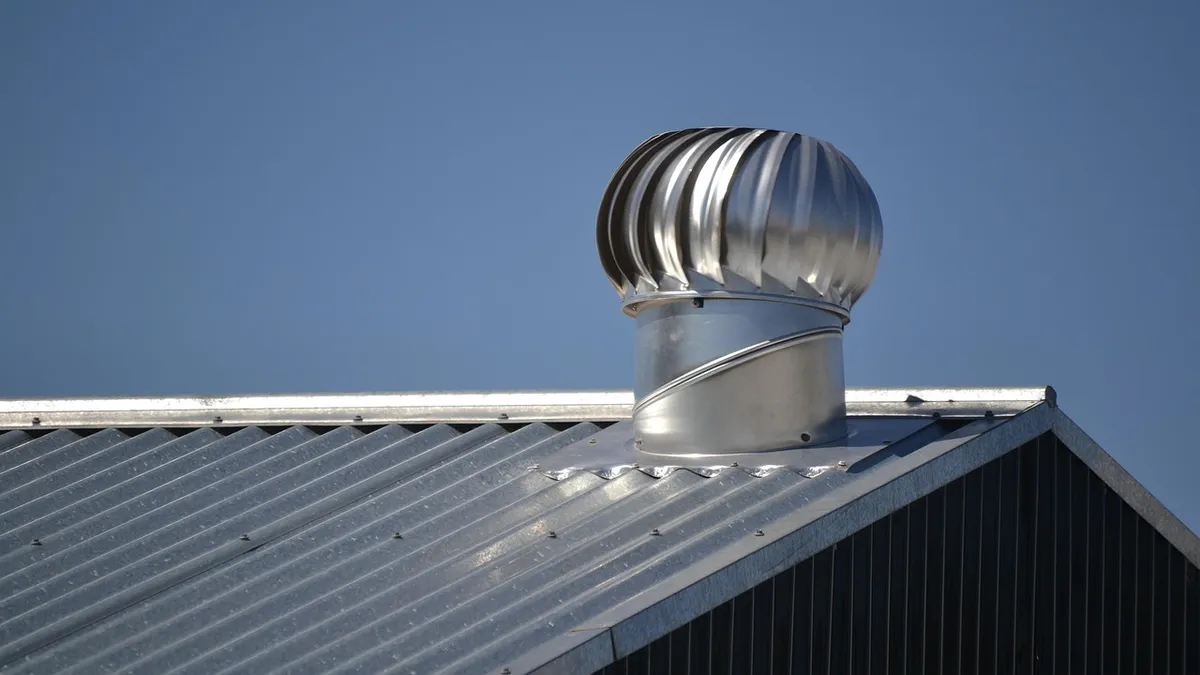
Image: sam_higgins_rulz via Pixabay
No. The International Residential Code (IRC) bars it outright: Section M1501.1 requires exhaust air to discharge to the outdoors instead of into an attic, soffit, ridge vent, or crawl space, and Section M1507.2 repeats that rule specifically for bathrooms, requiring the duct to discharge directly outdoors. If your fan already dumps into the attic, it needs to be rerouted, not left alone.
Key takeaways
- It’s not allowed, full stop. IRC Section M1501.1 (general exhaust systems) and Section M1507.2 (bathrooms specifically) both require exhaust air to discharge to the outdoors instead of into an attic, soffit, ridge vent, or crawl space.
- If a fan has been venting into the attic for a while, check for damage before you assume a simple reroute is all that’s needed: look for staining, dark spots, or soft wood on the roof sheathing above the duct opening.
- The fix is a reroute, not a patch. The duct has to run to a capped termination outside the building — through the roof or a sidewall — with a backdraft damper.
- Turn the breaker off before touching any wiring, and call a licensed electrician if the reroute involves moving the fan’s circuit or you find damaged wiring.
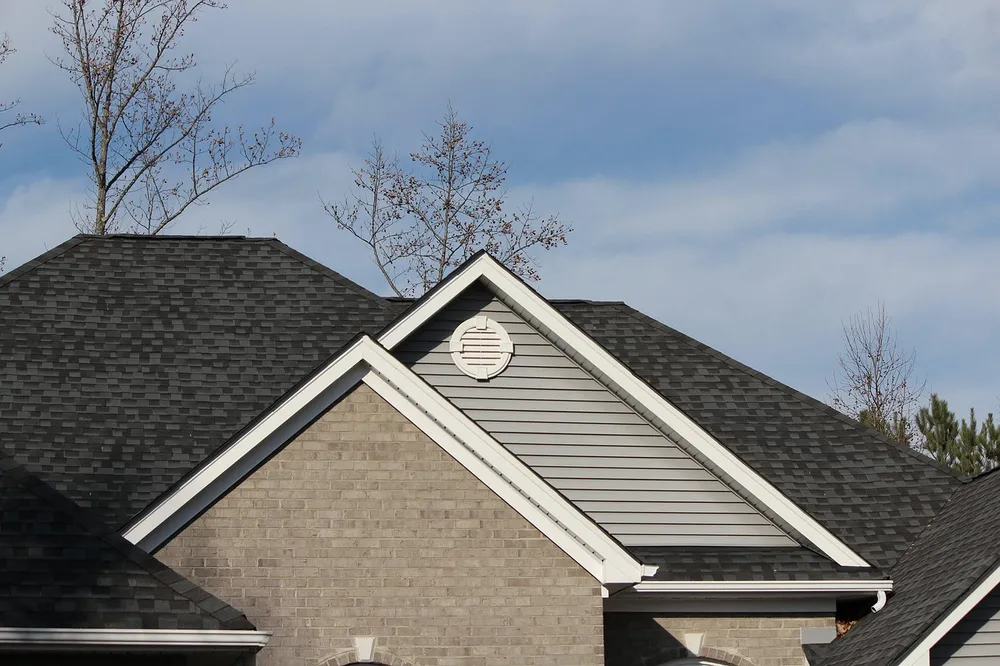
- A gable vent or soffit vent on the outside of the house is not a valid termination point — those vents exist to ventilate the attic itself, not to receive a bathroom fan duct.
What does the code actually say?
The International Residential Code (IRC) addresses this in two places in Chapter 15, Exhaust Systems. Section M1501.1 sets the general rule for every mechanical exhaust system in the house: the air has to discharge outdoors, and it may not be exhausted into an attic, soffit, ridge vent, or crawl space. Section M1507.2 then repeats the point specifically for bathrooms: “Exhaust air from bathrooms and toilet rooms shall not be recirculated within a residence or to another dwelling unit and shall be exhausted directly to the outdoors, and shall not discharge into an attic, crawl space or other areas inside the building.”
In plain English: the duct has to end outside the building envelope through a capped termination, not loose in the attic, not aimed at the soffit, and not tucked against a ridge vent. Code editions and local amendments vary by jurisdiction, so confirm the edition your area enforces with your building department — this is the IRC text as published for residential construction, checked against the source below on November 12, 2026.
This is also why a gable vent or the open soffit vents under your eaves don’t count as a fix. Those vents are there to let outside air move through the attic for passive ventilation. Pointing a bath fan duct at one of them, or leaving it open near one, just means the humid air gets pulled back into the attic through the same vents instead of leaving the building the way the code requires.
How do you know if your fan is venting into the attic?
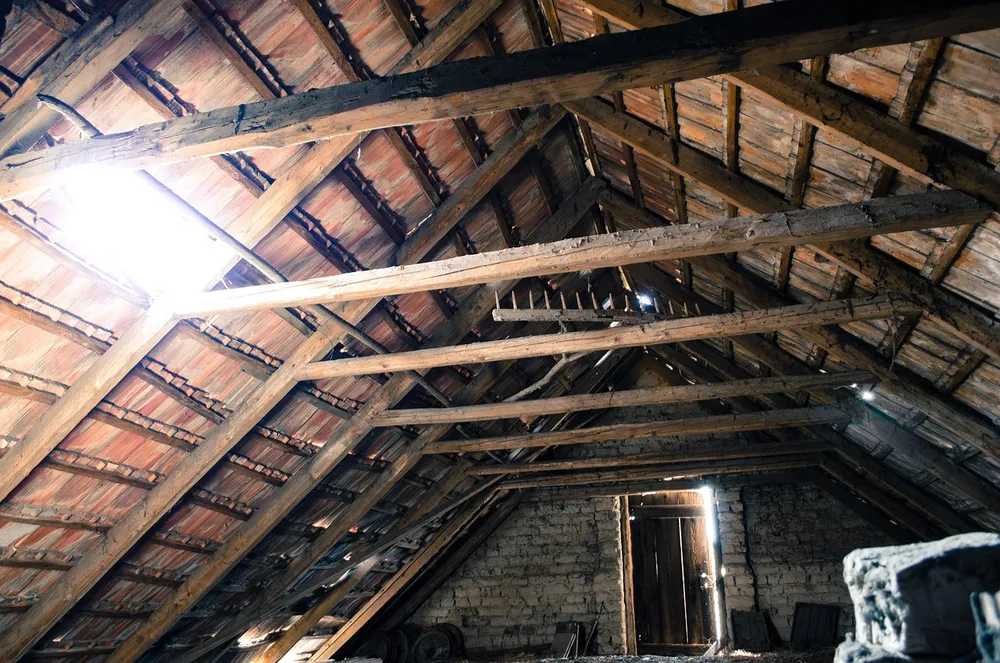
If you can safely access the attic, follow the duct by sight from the back of the fan housing. A code-compliant setup runs in one continuous, sealed tube to a capped opening in the roof or a wall. A fan that’s venting into the attic instead usually shows one of these signs: the duct simply stops and hangs open a few feet from the fan, the duct is crushed or disconnected partway along its run, or there’s no duct at all and the fan just blows straight into the attic space above the housing.
If you can’t trace it yourself, or the attic isn’t safely accessible, a home inspector or a licensed contractor can check it for you. This is also the kind of thing a home inspection commonly flags when a house is listed for sale.
What happens if it’s been venting into the attic for years?
A bathroom fan moves a lot of water vapor every time someone showers. When that air has nowhere to go but the attic, it meets the coldest surface up there — the underside of the roof sheathing — and condenses. The U.S. Environmental Protection Agency puts the basic fix plainly: “Use exhaust fans in bathrooms and kitchens to remove moisture to the outside (not into the attic).” When that moisture is instead dumped into the attic, it has nowhere to escape to.
Mold doesn’t need long to get started once a surface stays damp. The EPA notes that “it is important to dry water-damaged areas and items within 24-48 hours to prevent mold growth” — and an attic that gets a fresh dose of humid air every time someone showers rarely gets the chance to fully dry out between uses. Over time, that repeated condensation cycle is a common path to mold staining on the roof sheathing, damp or compacted insulation under the duct opening, and in persistent cases, softened or delaminating oriented strand board (OSB) sheathing where the wood has stayed wet for long periods.
Building science guidance on residential ventilation design is consistent on the underlying fix: exhaust ducts need to be sealed at every joint and fully terminated to the outdoors, not left to leak or empty out before they reach the exterior — running a duct through a soffit cavity without a dedicated, fully terminated cap, for example, is specifically called out as a setup to avoid because it lets air leak into the attic instead of leaving the building.
None of this means you need to tear out the roof. It means checking the attic above the duct opening for staining, soft spots, or a musty smell before you close things back up, and addressing any damage you find at the same time you reroute the duct.
Fixing it: reroute to the roof or a sidewall
There’s no code-compliant way to leave a fan venting into the attic. The duct has to be rerouted so it ends outside the building through a capped termination with a backdraft damper. Which direction makes sense depends on where the bathroom sits in the house.
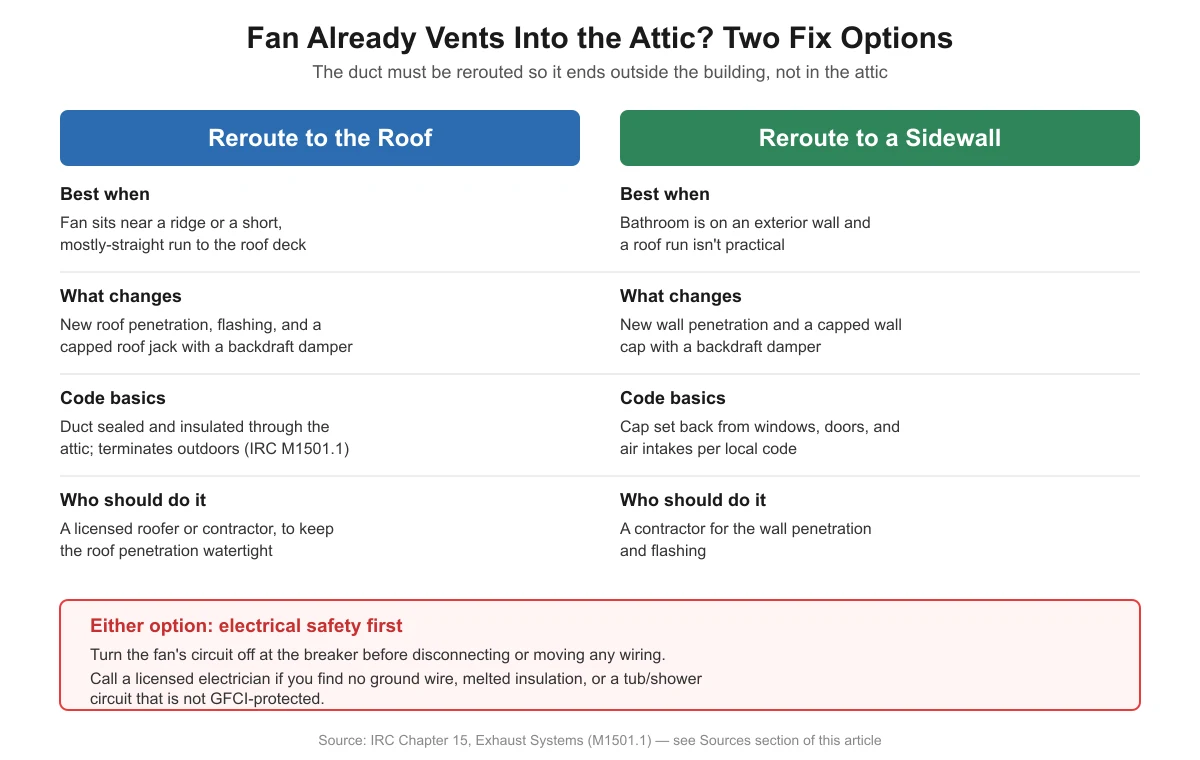
| Fix option | Best when | What changes | Who should do it |
|---|---|---|---|
| Reroute to the roof | The fan sits near a ridge, or there’s a short, mostly-straight run to the roof deck | New roof penetration, flashing, and a capped roof jack with a backdraft damper; the rest of the duct run through the attic gets sealed and insulated | A licensed roofer or contractor, to keep the roof penetration watertight |
| Reroute to a sidewall | The bathroom is on an exterior wall and a roof run isn’t practical | New wall penetration and a capped wall vent with a backdraft damper; often a shorter total duct run than going to the roof | A contractor for the wall penetration and flashing |
| Either option | Any reroute that involves disconnecting or moving the fan | Breaker off before any wiring is touched; GFCI protection confirmed if the fan is over a tub or shower | A licensed electrician if you find no ground wire, melted insulation, or a non-GFCI tub/shower circuit |
Before you touch any wiring to disconnect or move the fan, turn the fan’s circuit off at the breaker panel and confirm it’s dead. Call a licensed electrician instead of continuing yourself if you find no ground wire on the circuit, a junction box with more splices than it was built for, melted insulation, scorch marks, or a tub/shower circuit that isn’t GFCI-protected. For the full step-by-step on duct sizing, routing, and sealing once you’ve picked roof or sidewall, see how to vent a bathroom exhaust fan the right way.
If the fan itself is old enough that you’re considering replacing it at the same time as the reroute, see how to replace a bathroom exhaust fan without rewiring for what counts as a simple like-for-like swap versus a job that needs an electrician.
Frequently asked questions
How do I know if my bathroom fan vents into the attic instead of outside?
Trace the duct from the back of the fan housing if you can safely access the attic. It should run as one continuous, sealed tube to a capped opening in the roof or a wall. If the duct ends loose in the attic, is crushed or disconnected partway, or there’s no duct at all, the fan is venting into the attic. A home inspector or licensed contractor can check this for you if you can’t access the attic safely yourself.
What happens to the attic if a bath fan has been venting into it for years?
The water vapor from showers condenses on the coldest surface up there, usually the underside of the roof sheathing, since it has nowhere else to go. Over repeated cycles this can lead to staining or mold on the sheathing, damp or compacted insulation near the duct opening, and in persistent cases, softened or delaminating OSB where the wood has stayed wet. Check for these signs before you close everything back up after a reroute.
Can I just let the duct open near a gable or soffit vent instead of using a dedicated cap?
No. Gable and soffit vents exist to ventilate the attic itself, not to serve as a termination point for a bathroom fan. Humid air aimed at one of these vents, or simply left open nearby, can get pulled right back into the attic instead of leaving the building, which doesn’t meet the code’s outdoor-discharge requirement and doesn’t solve the moisture problem either.
Do I need a permit to reroute the duct to the roof or a sidewall?
Often yes, especially for a new roof or wall penetration. Permit rules are set locally, not by the IRC itself, so check with your building department before you start. If the reroute also involves moving the fan’s electrical circuit, a permit is even more likely to be required.
Sources
- International Residential Code, Chapter 15 – Exhaust Systems, Sections M1501.1 (Outdoor discharge) and M1507.2 (Recirculation of air), text as published via up.codes code viewer. Checked November 12, 2026.
- U.S. Environmental Protection Agency, What are the main ways to control moisture in your home? — guidance to vent bathroom exhaust fans to the outside, not into the attic.
- U.S. Environmental Protection Agency, Why is mold growing in my home? — the 24-48 hour window for drying damp surfaces before mold growth takes hold.
- Building Science Corporation, BSI-016: Top Ten Issues in Residential Ventilation Design — duct sealing and full outdoor termination requirements, including why running a duct into a soffit cavity instead of a dedicated cap is a problem.
bathroomexhaustfanventing.com Editorial Team. Last updated: November 12, 2026.