How Long to Run a Bathroom Fan After a Shower
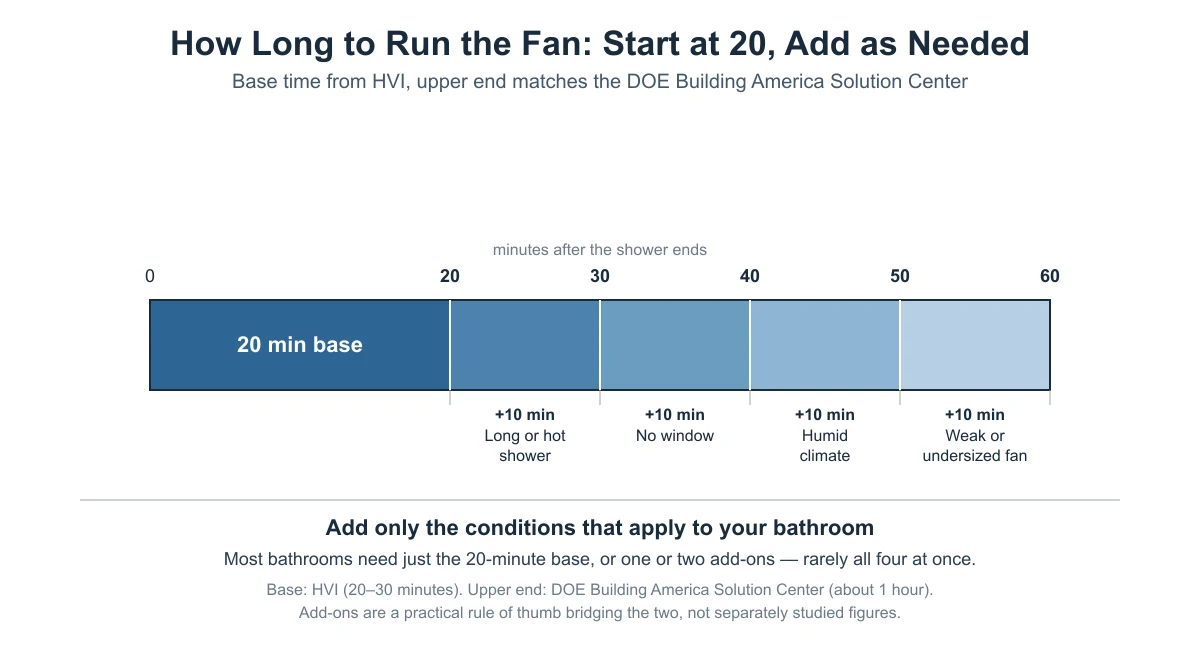
Run your bathroom fan 20 minutes after a shower as a baseline, then use this adjustment table for long showers, no window, humid climates, or a weak fan.
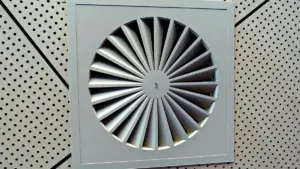
Image: AS_Photography via Pixabay
Run your bathroom fan at least 20 minutes after a shower, per Home Ventilating Institute guidance, and keep it on while you shower too. A long or hot shower, no window, a humid climate, or a weak fan can each add time, up to about an hour — matching the Department of Energy’s Building America Solution Center recommendation for full humidity control.
Key takeaways
- HVI’s published minimum is 20 to 30 minutes after each shower, not just a quick blast while you towel off.
- The DOE’s Building America Solution Center recommends a full hour for effective humidity control — a more conservative number than HVI’s minimum, not a contradiction of it.
- Start at a 20-minute base and add about 10 minutes for each condition that applies: a long or hot shower, no window, a humid climate, or a weak/undersized fan.
- The EPA notes mold can take hold on damp surfaces within 24 to 48 hours, so consistent run time matters more than hitting an exact minute count every single day.
- If you’re swapping the switch for a timer or humidity sensor, cut the breaker first and call a licensed electrician for anything beyond a simple like-for-like switch swap.
Why isn’t there one official number?
Search around and you’ll find a cluster of sites repeating “20 minutes” with no real explanation, plus two genuinely official sources that don’t say exactly the same thing. The Home Ventilating Institute (HVI), the trade association whose testing standards most bath fans are rated against, states: “Your fan should have a control that will allow the fan to run at least 20 to 30 minutes after each shower to ensure that moisture levels are reduced.” That’s a minimum, aimed at clearing the worst of the humidity.
The U.S. Department of Energy’s Building America Solution Center, a technical resource built on PNNL (Pacific Northwest National Laboratory) building-science research, goes further: it recommends leaving the fan running for a full hour after a shower for effective humidity control, and suggests a timer switch set to that duration rather than a plain wall switch you have to remember to flip off. Neither source is wrong — HVI gives a floor, BASC gives a target for thorough humidity control. The gap between them is exactly where your own bathroom’s conditions matter.
Start at 20 minutes, then adjust for your bathroom
Instead of memorizing one flat number, start with HVI’s 20-minute floor and add time for whichever of these apply to your bathroom. None of the individual add-ons below come from a published study — they’re a practical rule of thumb for bridging HVI’s 20-to-30-minute minimum and BASC’s one-hour target, not separately measured figures. Use your own judgment and the mirror-and-wall check further down to fine-tune.
| Starting point or condition | Time | Why |
|---|---|---|
| Base: right after any shower | 20 minutes | HVI’s published minimum to reduce moisture levels |
| + Long or very hot, steamy shower | +10 minutes (rule of thumb) | More total moisture went into the air to begin with |
| + No window to crack for extra airflow | +10 minutes (rule of thumb) | No second path for humid air to escape while the fan works alone |
| + Naturally humid climate or humid season | +10 minutes (rule of thumb) | Replacement air drawn in from outside carries less drying power |
| + Weak or undersized fan for the room | +10 minutes (rule of thumb), or resize the fan | Moves less air per minute, so clearing the same moisture load takes longer |
| All of the above stacked together | Up to about 60 minutes | Matches the Building America Solution Center’s one-hour recommendation for effective humidity control |
Most bathrooms only need the base or one or two add-ons, not all four at once. See Sources for the HVI and DOE/BASC figures behind the base and the one-hour ceiling.
Why each factor actually adds time
A long or very hot shower simply puts more water vapor into the air before the fan ever gets a head start on it, so it has more total moisture to remove once you’re done. A bathroom with no window loses its only passive route for humid air to leave the room on its own; the fan is doing the entire job by itself, which the EPA’s general advice to “run the fan or open a window” assumes you have at least one option working at a time — without a window, the fan needs longer to finish the job alone.
A humid climate or a humid stretch of the year works against the fan from the other direction: every cubic foot of moist indoor air the fan exhausts has to be replaced by outdoor air pulled in through gaps around doors and windows, and if that replacement air is already humid, it brings less drying capacity with it. And a fan that’s undersized for the room, or simply weaker than it used to be, moves less air per minute by definition, so it takes longer to exhaust the same amount of moisture. If you’re not sure your fan is sized correctly for your bathroom, see our CFM sizing chart by room size and fixture count.

A simple way to find your bathroom’s real number
The adjustment table is a starting point, not a substitute for watching your own bathroom. After your next shower, start the fan’s timer (or just note the time) and check back every 10 minutes or so: is the mirror still fogged? Is there visible condensation beading on the window, tile, or ceiling? Once those surfaces are dry to the touch, you’ve found your bathroom’s actual number for that day’s shower. A university extension guide on bathroom mold control also suggests a quick airflow check while the fan runs: crack the bathroom door and feel for air moving in underneath it. If you don’t feel any draw, the fan may not be pulling air as effectively as it should, which is a separate problem from simply needing more time — see our guide on a bathroom fan not pulling air if that’s the case.
Make the timing automatic instead of guessing every time
If you keep forgetting to turn the fan off, or keep running it far longer than needed just to be safe, a timer switch or a humidity-sensing switch removes the guesswork entirely. BASC specifically recommends controlling an intermittently-run bath fan with a timer switch rather than a plain wall switch, set to the runtime you’ve settled on. A humidity sensor switch goes a step further and shuts the fan off on its own once relative humidity actually drops, rather than after a fixed number of minutes. For help deciding which type fits your household’s habits, see bathroom fan timer vs. humidity sensor switch.
For the full picture on choosing a fan, routing the duct outdoors, and meeting code, start with our complete bathroom exhaust fan venting guide.
Safety note: swapping the switch is electrical work
A timer or humidity-sensor switch replaces the device on the wall that controls the fan’s power, which means working inside an electrical box. Turn the circuit off at the breaker before removing the old switch, and confirm it’s dead with a voltage tester before touching any wires — don’t rely on the wall switch alone to cut power. If the new switch needs a neutral wire that isn’t present, you find a missing ground, melted insulation, or any wiring you’re not confident about, stop and call a licensed electrician rather than continuing on your own.

Frequently asked questions
Does the fan need to run during the shower, or just after?
Both. The EPA’s general advice is to run the bathroom fan or open the window while showering, and extension guidance from NDSU similarly recommends running the exhaust fan during and for a period after showers. The after-shower window in this article is in addition to running the fan the whole time you’re actually showering, not a replacement for it.
What if my bathroom doesn’t have a window at all?
No code requires a window if you have a working exhaust fan vented outdoors; the fan is doing the job a window would otherwise help with. Treat “no window” as one of the add-on conditions in the table above, and lean on the mirror-and-wall check to confirm the extra time is actually enough for your specific bathroom.
Why do HVI and the DOE give different numbers?
HVI’s 20 to 30 minutes is a published minimum for reducing moisture levels; the Building America Solution Center’s one hour is its recommendation specifically for effective humidity control, a more thorough target. They’re not contradicting each other so much as answering slightly different questions — “enough to help” versus “enough to fully clear it.”
How do I know if 20 minutes isn’t enough for my bathroom?
Check the mirror, window, and ceiling a few minutes after the fan would normally shut off. Lingering fog or visible condensation means you need more time; add the relevant factor from the table (long shower, no window, humid climate, or a weak fan) and recheck after your next shower.
Will a humidity-sensing switch just pick the right number for me?
That’s exactly what it’s designed to do — it turns the fan off once relative humidity actually drops, instead of after a fixed number of minutes, so it adapts automatically to long showers or humid days. See timer vs. humidity sensor switch for how to decide which control fits your household.
Sources
- Home Ventilating Institute (HVI), Ventilating Living Areas — the 20-to-30-minute post-shower fan runtime recommendation. Checked November 12, 2026.
- U.S. Department of Energy, Building America Solution Center (PNNL), Bathroom Exhaust Fans — the one-hour recommendation for effective humidity control and timer-switch guidance. Checked November 12, 2026.
- U.S. Environmental Protection Agency, A Brief Guide to Mold, Moisture and Your Home — running the fan or opening a window while showering, 30-50% target relative humidity, and the 24-48 hour mold-growth window on damp surfaces. Checked November 12, 2026.
- Broan-NuTone, How long should a bath fan run after a shower is used? — manufacturer FAQ reinforcing the HVI-based 20-minute guidance. Checked November 12, 2026.
- North Dakota State University Extension, Control Mold Growth in the Bathroom — running the fan during and after showers, and checking for air movement under the bathroom door. Checked November 12, 2026.
bathroomexhaustfanventing.com Editorial Team. Last updated: November 12, 2026.