Bathroom Fan Timer vs. Humidity Sensor Switch
A timer switch runs for fixed minutes; a humidity sensor switch runs until RH drops. See the decision table, price gap, and safety steps first.
Image: Janvanbizar via Pixabay
A timer switch runs the bathroom fan for a fixed number of minutes you choose, no matter how humid the room is; a humidity sensor switch runs the fan until relative humidity actually drops below a set threshold. Choose a sensor if people forget to turn the fan off, and a timer for simple, shared, or rental bathrooms.
Key takeaways
- A timer switch always runs for the same preset minutes, however humid the room still is; a humidity sensor switch runs until the room’s actual relative humidity (RH) drops back below a threshold you pick.
- Humidity sensor switches fit best when someone in the house regularly forgets to switch the fan off, since the control handles that automatically.
- Timer switches fit best for shared, rental, or guest bathrooms, since there’s one button and nothing for anyone to mis-set.
- Expect a humidity sensor switch to cost more than a basic timer switch — roughly $10 to $60 more depending on brand, as of November 2026 (a rough range, not a quote).
- Some state codes require an adjustable humidity control on a bathroom fan that doesn’t run continuously; a plain timer switch alone doesn’t meet that kind of requirement.
Bathroom Fan Timer Switch vs. Humidity Sensor Switch: What’s the Difference?
A timer switch is the simpler of the two. You press one of its preset buttons — commonly 10, 20, 30, or 60 minutes, depending on the model — and it counts down, then shuts the fan off on its own. Leviton’s own countdown timer switches work this way: a single-pole switch with several preset time buttons and an LED showing which countdown is running, rated for up to about 1/2 HP or roughly 9.8A of fan or motor load, with no neutral wire required on most single-pole installs. The timer doesn’t know or care how humid the bathroom actually is; it just counts minutes and stops.
A humidity sensor switch adds a moisture sensor and a small processor instead of a plain clock. Leviton’s own FAQ for its humidity sensor and fan control switch describes the logic directly: “The Humidistat mode automatically turns ON a ventilation fan for a set period until the relative humidity (RH) is greater than or equal to the selected humidistat setting (35%, 50%, 65% or 80%).” In plain terms, the switch watches the room’s actual moisture level and keeps the fan running until that level drops back down, rather than running for a fixed number of minutes regardless of how damp the air still is. The same switch line also offers a second “Air Cycle” mode that just runs the fan on a repeating schedule (for example, 20 minutes on and 40 minutes off every hour) if you’d rather not rely on the humidity trigger, plus a manual button to run the fan on demand.
Independent ventilation guidance backs up using either kind of automatic control over a bare wall switch for a fan that only runs sometimes. The U.S. Department of Energy’s Building America Solution Center recommends controlling an intermittently-operated bathroom fan with a timer switch rather than a standard wall switch, and suggests leaving the fan running for about an hour after a shower for effective humidity control — guidance that applies whether the one-hour runtime comes from a timer’s preset or from a humidity sensor waiting for the air to actually clear.
Which switch fits your household?
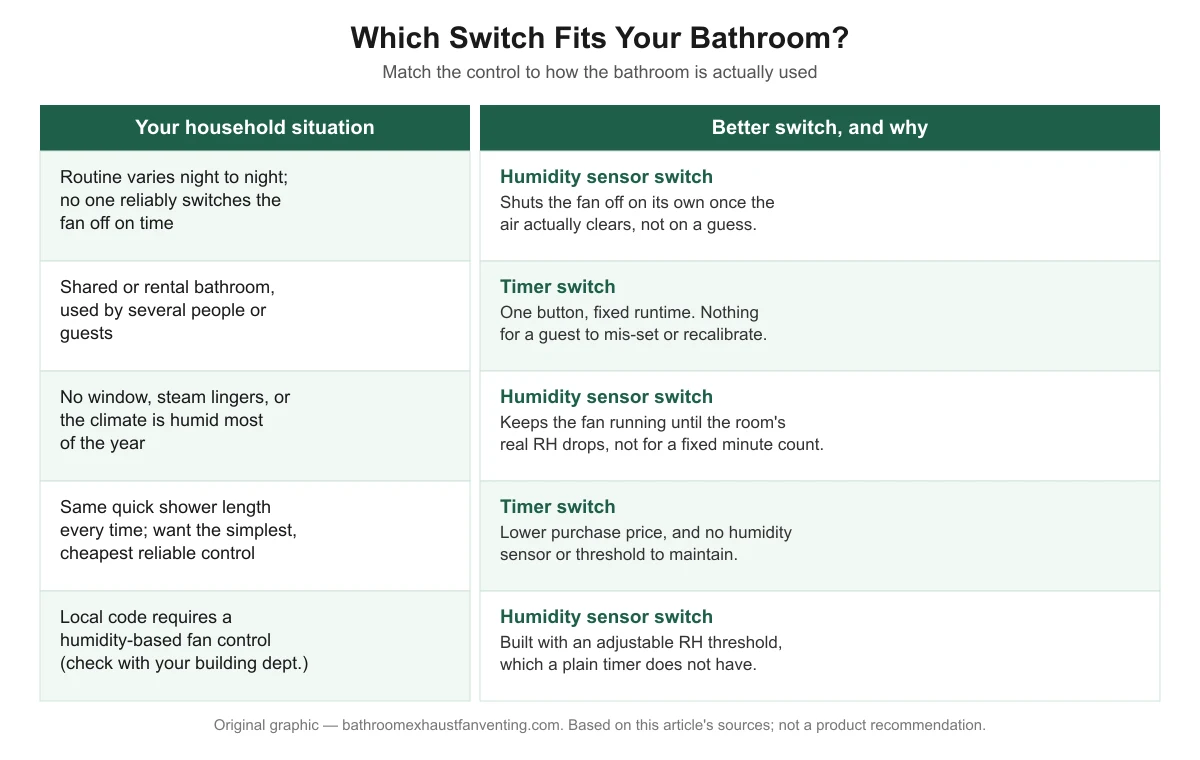
The right answer depends less on the bathroom and more on how the people using it actually behave. Match your situation to a row below.
| Your household situation | Better switch | Why |
|---|---|---|
| Routine varies night to night; no one reliably switches the fan off on time | Humidity sensor switch | Shuts the fan off on its own once the air actually clears, not on a guess. |
| Shared or rental bathroom, used by several people or guests | Timer switch | One button, fixed runtime. Nothing for a guest to mis-set or recalibrate. |
| No window, steam lingers, or the climate is humid most of the year | Humidity sensor switch | Keeps the fan running until the room’s real RH drops, not for a fixed minute count. |
| Same quick shower length every time; want the simplest, cheapest reliable control | Timer switch | Lower purchase price, and no humidity sensor or threshold to maintain. |
| Local code requires a humidity-based fan control (check with your building department) | Humidity sensor switch | Built with an adjustable RH threshold, which a plain timer does not have. |
What’s the real price difference?
Expect to pay more for the sensor, but not dramatically more if you’re comparing similar single-pole switches from the same manufacturer. As one example, Leviton’s own published prices for its Decora line (checked November 12, 2026) show its basic countdown timer switch at about $42 and its humidity sensor and fan control switch at about $50 — roughly an $8 gap between two switches built by the same company for the same kind of circuit. Shopping more broadly across mainstream retailers that same month showed a wider spread for other brands, commonly $20 to $60 more for an automatic humidity-sensing switch than for a basic timer. Treat these as rough figures, not a price quote: check current pricing before you buy. This guide isn’t recommending a specific brand or model — it’s showing you the shape of the price gap so you can decide if the automatic control is worth it for your bathroom.
| Switch type | Typical price range (checked November 2026) | Notes |
|---|---|---|
| Basic countdown timer switch | Roughly $35–$50 | Single-pole; no neutral wire required on most models. |
| Humidity sensor and fan control switch | Roughly $45–$75 | Wider range across brands; some models add a timer override or light control. |
Does your area require a humidity-based control?
Some state codes set a minimum standard for humidity controls specifically, which a plain timer switch doesn’t satisfy on its own. California’s green building code requires that a bathroom exhaust fan not functioning as part of a whole-house ventilation system be controlled by a humidity control, and specifies that “humidity controls shall be capable of adjustment between a relative humidity range of ≤ 50 percent to a maximum of 80 percent.” That’s a requirement about the control’s adjustability, not a style preference — a basic timer switch, with no humidity sensing at all, doesn’t meet it. Rules like this vary by state and by whether the fan is part of a larger continuous-ventilation system, so check with your local building department before you buy if you’re doing a permitted install or remodel, rather than a like-for-like swap of a worn-out switch.
Before you install either switch, it’s electrical work
Turn the circuit off at the breaker before you touch either switch, and confirm it’s dead with a voltage tester before you remove the wall plate. Swapping a wall switch is electrical work, even though it looks like a simple parts swap, because you’re working inside a box with wiring that’s live until the breaker is off. Don’t rely on the old switch being “off” to mean the box is safe — always kill the breaker first.
- Turn off the breaker for that circuit, not just the wall switch, before you open the box.
- Confirm the wires are dead with a voltage tester before touching any connection.
- If the box has no neutral wire and your chosen switch requires one, or if you find aluminum wiring, a shared neutral, or anything you don’t recognize, stop and call a licensed electrician rather than guessing.
- If you’re adding a 3-way switch or a combination light/fan/humidity control rather than a simple single-pole swap, call a licensed electrician — the wiring is no longer a straightforward like-for-like job.

If you’re starting from scratch — installing a fan for the first time or re-venting an existing one — see our complete guide to how to vent a bathroom exhaust fan the right way, which covers duct sizing and routing before you ever get to the switch. And once you’ve picked a control, how long the fan actually needs to run matters just as much as which switch does it — see our guide to how long to run a bathroom fan after a shower for adjustments by shower length, room size, and climate.
Frequently asked questions
Do these switches need a neutral wire?
Leviton’s own single-pole countdown timer and humidity sensor switches are both built to work without a neutral wire in most installations, using the existing hot and load wires. Requirements can still vary by brand and by whether you’re installing a 3-way or combination light/fan control, so check the specific switch’s wiring diagram before you buy or open the box.
Can one switch combine a timer and a humidity sensor?
Yes. Some manufacturers sell combination switches that pair a humidity sensor with a timer override, or with the bathroom light control, in a single unit. These typically cost more than either control alone, but they let you set a backup runtime in case the humidity sensor’s automatic shutoff doesn’t suit a particular shower.
Will a humidity sensor switch run the fan constantly and raise my electric bill?
No — that’s the opposite of how it’s designed to work. A humidity sensor switch turns the fan off once the room’s relative humidity drops back below the threshold you set, rather than running on a guess. A timer switch left on a long setting, or restarted out of habit, can actually run longer than needed more often than a sensor that shuts off on its own.
Is swapping the switch a DIY job, or do I need an electrician?
A simple, like-for-like single-pole swap, with the breaker confirmed off and the existing wiring in good condition, is often within reach for a careful DIYer. If the box lacks a wire your new switch needs, shows damaged or aluminum wiring, or you’re adding a 3-way or combination control, stop and call a licensed electrician rather than improvising.
Does my state require a humidity-sensing switch on a bathroom fan?
Some do. California’s green building code, for example, requires a humidity control adjustable between 50% and 80% relative humidity on fans that aren’t part of a whole-house ventilation system. Rules vary by state and by project type, so check with your local building department before you buy, especially for a permitted install or remodel rather than a direct swap.
Sources
- Leviton Manufacturing, Frequently Asked Questions: Decora Humidity Sensor and Fan Controls — manufacturer documentation describing Humidistat mode, Air Cycle mode, and the 35/50/65/80% relative humidity settings. Checked November 12, 2026.
- Leviton Manufacturing, Decora In-Wall Humidity Sensor and Fan Control Switch (DHS05) — manufacturer specifications and published price. Checked November 12, 2026.
- Leviton Manufacturing, Decora In-Wall 60-Minute Countdown Timer Switch (DT160-1LW) — manufacturer specifications and published price. Checked November 12, 2026.
- Pacific Northwest National Laboratory, Building America Solution Center, Bathroom Exhaust Fans — U.S. Department of Energy-affiliated guidance recommending a timer switch over a standard wall switch for intermittent fan operation. Last reviewed December 4, 2022; checked November 12, 2026.
- California Green Building Standards Code (CALGreen), Section 4.506.1.2.1, as reproduced by up.codes — the state code requirement that humidity controls be adjustable between 50% and 80% relative humidity. Checked November 12, 2026.
bathroomexhaustfanventing.com Editorial Team. Last updated: November 12, 2026.